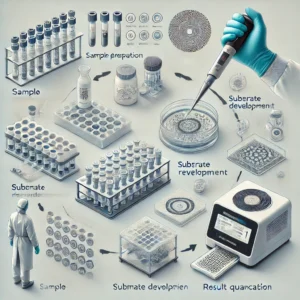
Key Components:
- Pre-Coated Microplate: Wells coated with Jagged-1-specific capture antibodies.
- Detection Antibody: Enzyme-conjugated antibody for signal amplification.
- Standards and Controls: For accurate calibration and assay validation.
- Substrate Solution: Produces a measurable colorimetric or chemiluminescent signal proportional to Jagged-1 concentration.
Assay Protocol:
- Sample Preparation: Dilute biological samples (e.g., serum, plasma, cell culture supernatants) as per the protocol.
- Capture Phase: Add samples to the wells; Jagged-1 binds to the immobilized antibodies.
- Detection Phase: Apply enzyme-linked detection antibodies to form a sandwich complex.
- Signal Development: Add substrate solution; enzyme catalyzes a reaction, producing a detectable signal.
- Quantification: Measure absorbance or luminescence using a microplate reader.
This precise protocol minimizes variability, ensuring reproducible results across experiments (FDA.gov).
Applications of the Jagged-1 ELISA Kit
1. Cancer Research
- Biomarker Discovery: Jagged-1 levels serve as biomarkers for cancer prognosis and therapy response.
- Therapeutic Targeting: Quantifying Jagged-1 helps evaluate the efficacy of Notch pathway inhibitors in preclinical trials (NCI.gov).
2. Developmental Biology
Understanding Jagged-1’s role in embryonic development sheds light on congenital disorders, aiding in the design of gene therapies (NIGMS.nih.gov).
3. Immunology
Jagged-1 influences T-cell differentiation and macrophage activation, making it a focus in autoimmune disease research (Genome.gov).
4. Regenerative Medicine
Studies on Jagged-1’s involvement in stem cell niches and tissue repair open avenues for regenerative therapies (NSF.gov).
5. Cardiovascular Research
The protein’s role in angiogenesis and vascular remodeling positions it as a target for cardiovascular disease studies (NIH.gov).
Advantages of the Jagged-1 ELISA Kit
- High Sensitivity and Specificity
- Detects minute quantities of Jagged-1 with negligible cross-reactivity with other proteins.
- Critical for analyzing low-abundance samples (CDC.gov).
- Versatility
- Compatible with various biological samples, enhancing its applicability across disciplines.
- Reproducibility
- Provides consistent results, essential for longitudinal studies and large-scale screenings.
- Ease of Use
- Ready-to-use reagents and straightforward protocols streamline the workflow for researchers at all expertise levels (PubMed.ncbi.nlm.nih.gov).
Emerging Trends and Future Directions
1. Personalized Medicine
Quantifying Jagged-1 in patient samples can help tailor therapies in oncology and rare genetic disorders (FDA.gov).
2. Advanced Assay Formats
Integration of Jagged-1 ELISA with multiplex platforms enables simultaneous quantification of multiple Notch pathway components, increasing research efficiency (NIH.gov).
3. Clinical Diagnostics
Further validation of Jagged-1 as a diagnostic and prognostic marker may lead to its inclusion in clinical testing panels (NIST.gov).

Conclusion
The Jagged-1 ELISA Kit is a powerful tool for elucidating the biological and pathological roles of Jagged-1. Its applications span basic research, biomarker discovery, and therapeutic development, making it invaluable for scientists and clinicians alike. By providing accurate and reliable data, the kit supports advancements in cancer research, developmental biology, regenerative medicine, and more.
For detailed protocols and expert guidelines, consult resources like NIH.gov, FDA.gov, Genome.gov, and NIST.gov. Through such tools, the scientific community continues to unlock the potential of Jagged-1 in addressing some of the most pressing challenges in health and disease.