
Proteinase K (Lyophilized Powder): A Comprehensive Guide to Its Applications and Benefits in Scientific Research
Introduction to Proteinase K
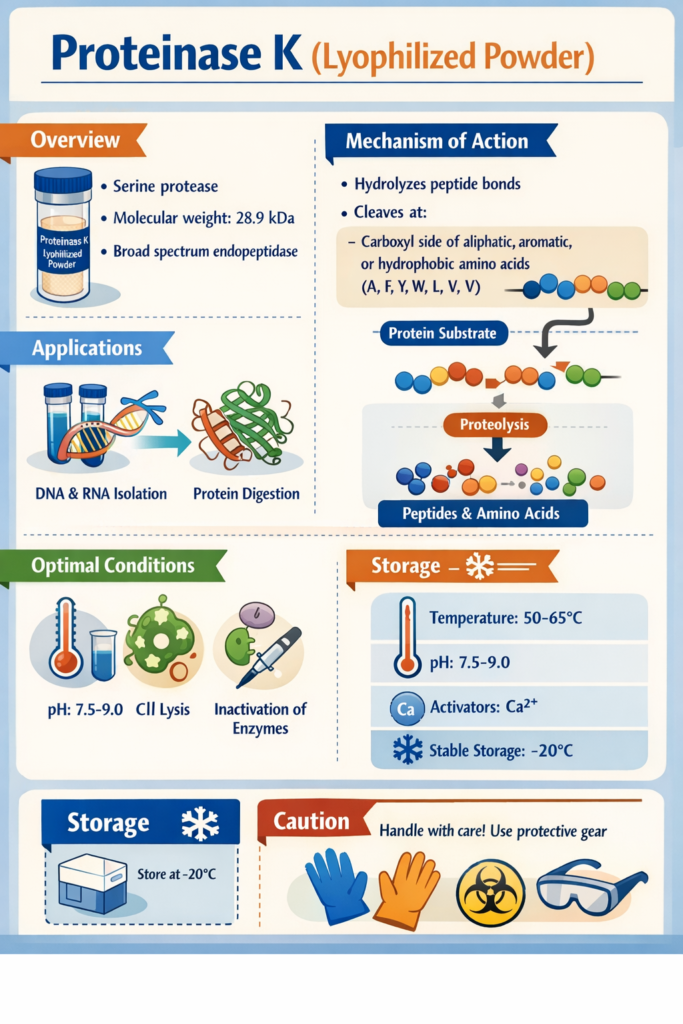
Proteinase K is one of the most important enzymes used in molecular biology and biotechnology laboratories worldwide. It is a highly effective serine protease that catalyzes the degradation of proteins, breaking down peptide bonds and leaving intact the nucleic acids required for further analysis. Initially isolated from the fungus Tritirachium album, Proteinase K is a staple in DNA and RNA purification protocols due to its versatility and efficiency. Available in a lyophilized powder form, it is stable and easy to handle, offering significant advantages in both long-term storage and ease of use in experimental protocols.
This guide will explore the many applications of Proteinase K in scientific research, its specific benefits, and why it remains a critical tool in molecular biology workflows. Additionally, we will look at how this enzyme is used across a range of disciplines and why it is so crucial for maintaining high-quality scientific results.
What is Proteinase K?
Proteinase K is a broad-spectrum protease enzyme that is most commonly used for the removal of contaminating proteins from biological samples during DNA, RNA, or protein extractions. The enzyme’s ability to degrade proteins across a wide range of conditions makes it extremely useful for researchers in diverse fields of biology and medicine. Its ability to function in harsh conditions (like high salt concentrations, detergents, and even high temperatures) makes Proteinase K especially useful for laboratory applications involving cell lysis, protein digestion, and nucleic acid isolation.
While Proteinase K works optimally at temperatures between 55–65°C, it is active across a broad range of pH and is highly resistant to inhibitors such as detergents and chaotropic agents. This adaptability allows researchers to incorporate it into multiple laboratory protocols with confidence that it will perform reliably, regardless of experimental conditions.
Key Applications of Proteinase K
Proteinase K is a versatile tool that supports a wide range of applications. Below are some of the most common and scientifically relevant uses of this protease in research and clinical laboratories:
1. DNA and RNA Purification
Proteinase K plays a pivotal role in many nucleic acid extraction protocols. During the isolation of DNA or RNA, the enzyme is used to degrade protein contaminants that could otherwise interfere with the analysis. Whether the sample comes from tissues, cells, or blood, Proteinase K ensures that nucleic acids are separated from the complex matrix of proteins, lipids, and other cellular components. In particular, its use is prevalent in genomic DNA extraction protocols, ensuring that the extracted DNA is pure and of high quality for subsequent experiments like PCR, cloning, and sequencing.
For example, studies published by NIH highlight the enzyme’s crucial role in the extraction of genomic DNA from challenging biological samples, including plant tissues and blood samples. By efficiently digesting proteins, Proteinase K helps improve the overall yield of high-quality nucleic acids.
2. Cell Lysis
In addition to its role in nucleic acid isolation, Proteinase K is an important reagent for cell lysis protocols. The enzyme breaks down cellular proteins, including membrane-bound proteins, allowing the release of nucleic acids into the solution. When combined with detergents or other chemical agents, Proteinase K helps lyse cell membranes while ensuring that proteins are removed from the lysate, yielding high-purity samples of DNA or RNA. The enzyme’s ability to act in a wide variety of buffers and with various lysis agents makes it ideal for cellular extraction in research studies (PubMed).
3. Protein Digestion and Analysis
Proteinase K is often used in protein digestion protocols for proteomics research. By digesting proteins into smaller peptides, the enzyme facilitates the identification of specific protein components through mass spectrometry and other techniques. Its broad substrate specificity means that it can digest a wide range of proteins, including those with complex or poorly characterized structures. This makes Proteinase K a valuable tool for understanding protein function, structure, and interactions.
For instance, proteomics research published by U.S. Department of Energy utilizes Proteinase K for systematic protein breakdown, helping to analyze protein-protein interactions and identify key structural elements that might be vital for therapeutic research.
4. Inactivation of Nucleases
During DNA or RNA purification, it is critical to prevent the degradation of genetic material by nucleases. Proteinase K helps to inactivate nucleases, which might otherwise break down the fragile nucleic acids. This ability makes Proteinase K indispensable when working with precious samples, such as cell cultures or clinical specimens, where maintaining the integrity of DNA and RNA is paramount. Nuclease inactivation using Proteinase K has been widely documented in molecular biology journals (CDC).
5. Histology and Immunohistochemistry
In histology and immunohistochemistry (IHC), Proteinase K is used for antigen retrieval, a process that unblocks epitopes in formalin-fixed, paraffin-embedded tissue sections. This retrieval is essential for enhancing the visibility of antigens that may be masked during tissue fixation. The enzyme is particularly useful when dealing with difficult tissues or cross-linked proteins, as it digests unwanted protein material while preserving antigenic epitopes for detection. Protocols using Proteinase K for IHC are described by institutions like NIH’s National Cancer Institute.

Why Choose Lyophilized Proteinase K?
1. Long-Term Stability
Lyophilized Proteinase K offers excellent stability over time. The lyophilization process removes water, preserving the enzyme in a dry form that is resistant to degradation. As a result, Proteinase K in lyophilized powder form can be stored for extended periods without loss of enzymatic activity, making it a cost-effective and reliable option for laboratories. The storage stability of Proteinase K is a key reason why it is widely used across multiple experiments and applications (FDA).
2. Easy Handling and Storage
Unlike liquid formulations, lyophilized Proteinase K does not require refrigeration during storage, making it easy to handle and transport. The powder can be reconstituted quickly by adding an appropriate buffer when needed. This convenience is particularly beneficial for labs that need to scale up operations or work in multiple locations. Moreover, long-term storage at -20°C ensures that the enzyme retains its full activity for long periods, making it a reliable resource for ongoing experiments.
3. Broad Substrate Specificity
Proteinase K’s broad specificity means it is effective on a wide variety of proteins, including membrane-bound proteins and nuclear proteins. This makes it an excellent choice for a wide range of experimental designs, from simple DNA extractions to complex proteomics analyses. Its robust activity in the presence of detergents, chaotropic agents, and other denaturing agents further enhances its versatility across different experimental setups.
The Science Behind Proteinase K
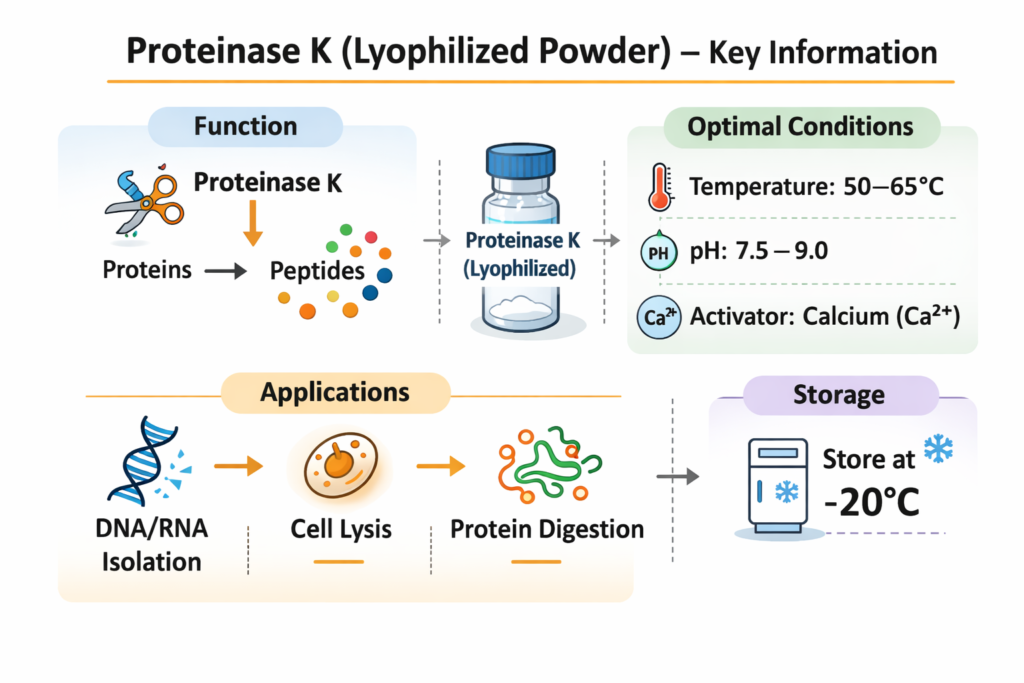
Proteinase K is a serine protease, meaning it relies on a serine residue in its active site to perform proteolysis. This enzyme exhibits proteolytic activity by hydrolyzing peptide bonds within polypeptides. Its broad substrate specificity allows it to act on various proteins under diverse conditions, including in the presence of organic solvents or high ionic strength solutions.
Its optimal pH ranges from 7.5 to 9.0, making it suitable for a variety of extraction buffers. Moreover, Proteinase K retains its activity at higher temperatures (typically 55–65°C), which allows it to be used in protocols that require thermal denaturation, such as in genomic DNA isolation or protein digestion experiments.
Scientific Research with Proteinase K: A Key Tool for Reliable Results
Numerous studies and scientific protocols demonstrate the effectiveness of Proteinase K in a wide range of research applications. The enzyme’s robust activity under various conditions has made it a go-to enzyme for both academic and commercial research. By providing researchers with a reliable method for removing proteins and other contaminants, Proteinase K enables the extraction of high-purity nucleic acids and protein analysis, which are critical for accurate and reproducible experimental results. For additional resources on Proteinase K applications, check out publications available through University of California and National Science Foundation.
Conclusion: Why Proteinase K is Indispensable in Your Research Workflow
Whether you are conducting genomic DNA extraction, RNA purification, or protein analysis, Proteinase K in its lyophilized powder form is an indispensable tool for your laboratory. Its stability, ease of use, and broad-spectrum activity make it essential for a variety of applications in molecular biology and biotechnology. By integrating Proteinase K into your protocols, you can be assured of high-quality, reproducible results every time.

Matrix hESC-Qualified, LDEV-Free: A Superior Substrate for Human Embryonic Stem Cell Culture
AffiLINK® Labeling Kits for 1mg of IgG
Comparative Performance of the Canivet Asian4 VetDx Test in Multi-Species Veterinary Diagnostics
About Author
