
A Comprehensive Guide to Bovine Serum Albumin (BSA), Standard Grade
Bovine Serum Albumin (BSA) is a highly versatile and essential protein that plays a critical role in many molecular biology, biochemical, and clinical laboratory applications. Its reliability, stability, and ease of use make it one of the most commonly employed reagents in scientific research worldwide. This article provides a detailed exploration of BSA, focusing on its composition, benefits, applications, and best practices for handling and storage.
Whether you’re working with protein assays, enzyme reactions, or cell culture, BSA’s broad range of uses ensures its place as an indispensable tool in laboratories. In this guide, we will explore why BSA (Standard Grade) is preferred in research, delve into its key applications, and explain how to use it effectively.
What is Bovine Serum Albumin (BSA)?
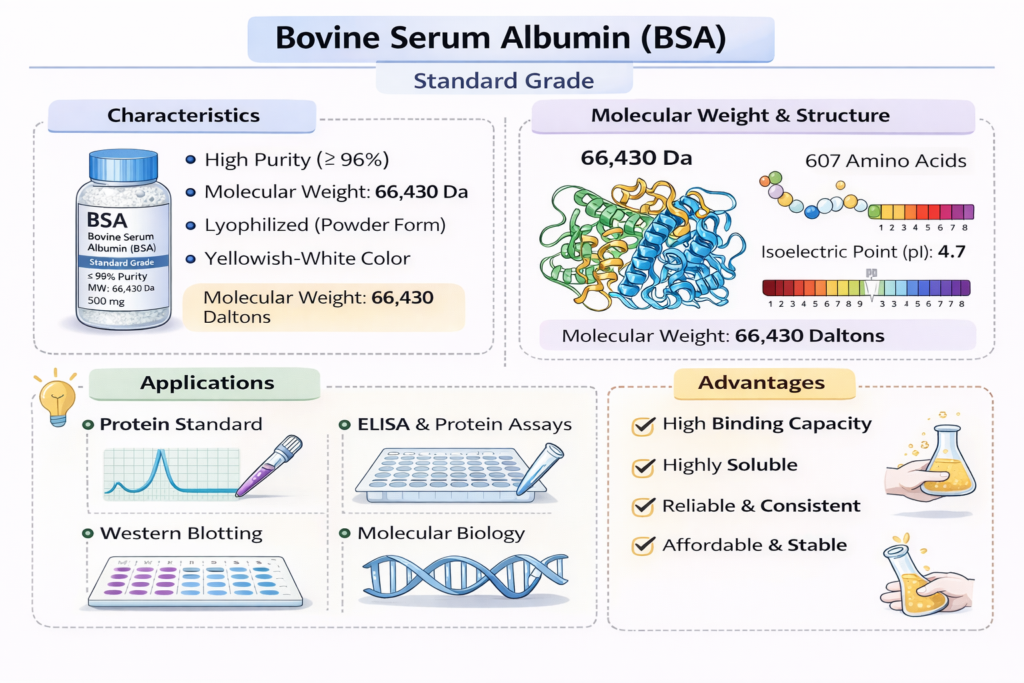
Bovine Serum Albumin (BSA) is a protein derived from cow blood serum. It is a globular protein that consists of a single polypeptide chain of approximately 583 amino acids and has a molecular weight of approximately 66.5 kDa. BSA is the most abundant protein in bovine serum, making up about 60% of the total protein content. It plays a vital role in maintaining osmotic pressure, transporting fatty acids, hormones, and other molecules, and stabilizing various biomolecules within the bloodstream.
In the laboratory, BSA (Standard Grade) is commonly used due to its high solubility, stability, and versatility. The Standard Grade of BSA refers to its relative purity level, typically ranging from 95% to 99%, making it suitable for most applications where ultra-high purity is not required. This grade ensures that BSA is free from significant contaminants, ensuring it works well in a range of scientific protocols without causing interference.
Key Properties of Bovine Serum Albumin (BSA)
Understanding the key properties of BSA is essential for optimizing its use in laboratory experiments. Below are the major characteristics that make BSA a versatile reagent:
1. Stability and Longevity
BSA is highly stable, which makes it ideal for long-term storage and use in various laboratory applications. It is resistant to degradation under normal laboratory conditions, even after extended periods in solution, making it a preferred choice for experiments that require consistent protein behavior.
2. Solubility
BSA is highly soluble in water, forming a stable, clear solution at concentrations ranging from 1 mg/mL to higher concentrations used for various applications. This solubility also makes BSA easy to dilute or concentrate, depending on the requirements of your experiment.
3. Protein Binding Capacity
One of the most important properties of BSA is its ability to bind to a wide variety of molecules, including fatty acids, hormones, drugs, and ions. This ability makes it an excellent stabilizer for proteins in various applications, as it prevents proteins from binding to surfaces or aggregating during storage or assays.
4. Non-interference in Reactions
BSA is generally non-reactive with most biological molecules, meaning it does not interfere with the assays it is used in, including enzyme assays, immunoassays, and protein assays. This makes it an ideal substance for blocking agents, stabilizers, and protein standards.
Applications of Bovine Serum Albumin (BSA), Standard Grade
BSA is widely used across many disciplines, including molecular biology, biochemistry, and immunology. Below, we highlight the most common and significant applications of BSA (Standard Grade) in laboratory settings.
1. Protein Assays and Quantification
Bovine Serum Albumin is widely used as a protein standard in protein assays. The Bradford assay, Lowry assay, and BCA assay are all common methods for measuring protein concentration, and BSA is often used to generate a standard curve. In these assays, known concentrations of BSA are prepared and used to calibrate the instrument. This allows researchers to measure the protein concentration of unknown samples by comparing their absorbance to the BSA standard curve.
-
Bradford Assay: The Bradford Protein Assay utilizes Coomassie Brilliant Blue, a dye that binds to proteins, causing a shift in the dye’s absorbance maximum. BSA is often used to create the standard curve for these assays.
-
Lowry Assay: This assay involves the reaction of proteins with Folin-Ciocalteu reagent, producing a color change. BSA is commonly used to prepare the standard concentration for calibration.
For more on protein quantification methods, refer to Protein Assay Methods.
2. Enzyme Stabilization in Enzyme Assays
In enzyme assays, BSA is frequently used as a stabilizing agent. It helps to stabilize enzymes during the reaction process, preventing the enzymes from degrading or aggregating. Enzymes, especially those with sensitive structures, require a stable environment for optimal activity. By preventing nonspecific binding and stabilizing the enzyme, BSA ensures more accurate results in enzyme kinetics studies and assays.
Common applications include:
-
Enzyme-linked Immunosorbent Assays (ELISA)
-
Proteinase assays
-
Kinase assays
Learn more about enzyme stabilization with BSA in Enzyme Assays.
3. Blocking Agent in Immunoassays
In immunology, BSA is frequently used as a blocking agent in immunoassays like Western blotting, ELISA, and immunohistochemistry. After proteins or antigens are immobilized on a membrane or plate, BSA is added to block nonspecific binding sites, preventing antibodies from binding to unwanted surfaces.
BSA blocks unoccupied sites in the test sample, ensuring that the antibodies used in these assays bind specifically to the target proteins or antigens. It improves the specificity of the assay and reduces background noise.

4. Cell Culture Media Supplementation
In cell culture, BSA is commonly used as a supplement to culture media. It provides essential nutrients and helps maintain the osmotic pressure within the cell culture environment. BSA also stabilizes growth factors, ensuring that they remain active in the media for extended periods.
For primary cell cultures, stem cell cultures, and even certain cell lines, BSA plays a critical role in promoting cell growth and maintaining cell health. BSA’s ability to bind to lipids also provides a source of fatty acids, which is crucial for cell metabolism and growth.
Refer to cell culture guidelines from the American Type Culture Collection (ATCC) for more on using BSA in cell cultures.
5. Protein Purification and Chromatography
In protein purification experiments, BSA is used to block nonspecific binding sites during affinity chromatography and size-exclusion chromatography. By preventing unwanted proteins from binding to the chromatography matrix, BSA helps improve the purity of the isolated protein.
BSA is also used in ion-exchange chromatography, where it prevents the adsorption of the target protein to the chromatography column material, ensuring that only the desired protein binds to the matrix.
6. Western Blotting and Immunoblotting
BSA is commonly used in Western blotting and immunoblotting. After the protein sample is separated via electrophoresis and transferred to a membrane (typically nitrocellulose or PVDF), the membrane is incubated with BSA to block nonspecific binding. This step is crucial in reducing background noise during antibody detection. The membrane is then incubated with primary and secondary antibodies to detect the protein of interest.
7. DNA Amplification and PCR
In polymerase chain reaction (PCR), BSA is used to stabilize DNA polymerase. The enzyme used in PCR reactions can often degrade under heat and pressure. BSA helps prevent this degradation, ensuring that the DNA polymerase remains active throughout the amplification process.
Benefits of Bovine Serum Albumin (BSA), Standard Grade
1. Reliability and Consistency
Due to its predictable behavior, BSA is a highly reliable reagent in experiments. The Standard Grade ensures that BSA works consistently across a wide variety of applications, providing accurate results when used in protein assays, enzyme reactions, and more.
2. Widely Available and Cost-Effective
BSA is widely available from most laboratory suppliers, making it easy to acquire in bulk for regular use. Compared to other proteins used for similar applications, BSA is relatively inexpensive, making it a cost-effective solution for most laboratories.
3. Non-Toxicity
BSA is generally regarded as non-toxic to cells and proteins, making it an ideal reagent for experiments involving living cells or sensitive protein reactions. It does not interfere with most cellular processes or biomolecule interactions, allowing researchers to use it confidently in a wide range of applications.
Best Practices for Storing and Handling Bovine Serum Albumin (BSA)
1. Storage Conditions
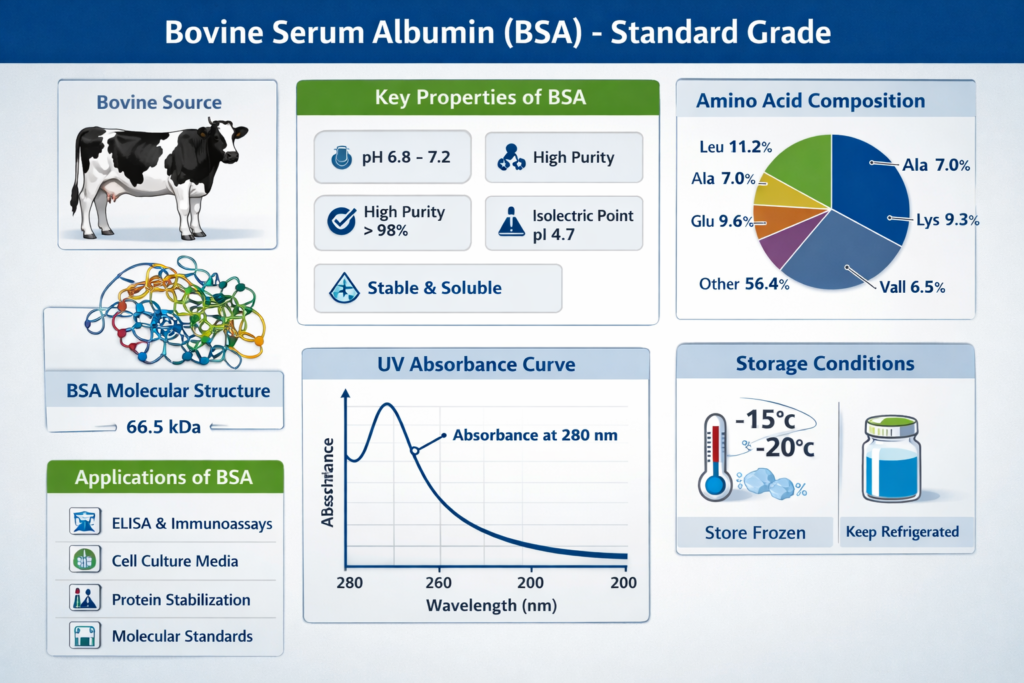
BSA (Standard Grade) should be stored in a cool, dry place, ideally at 2-8°C. This prevents it from degrading or forming precipitates. For long-term storage, it can be aliquoted and stored at -20°C. Ensure the solution is tightly sealed to avoid contamination. Avoid repeated freeze-thaw cycles, as they can cause the protein to degrade.
2. Handling and Contamination Prevention
To prevent contamination of BSA:
-
Always use sterile pipettes and clean containers when handling.
-
Never touch the reagent directly with bare hands to avoid introducing bacterial contamination.
-
Always check for visible precipitates or turbidity, which may indicate degradation or contamination.
Conclusion: Why Bovine Serum Albumin (BSA) is a Vital Reagent in Scientific Research
Bovine Serum Albumin (BSA), Standard Grade, is a cornerstone in the toolkit of researchers across various fields of scientific study. From protein assays and enzyme stabilization to immunoassays and cell culture, BSA continues to prove its versatility and reliability in the laboratory. Its high stability, ease of use, and non-reactivity with biological samples make it an ideal reagent for routine and specialized experiments alike.

Optimizing Giemsa Stain PR80 for Accurate Cytogenetic Analysis in Cancer Diagnostics
Genetics and breeding of a black-bone and blue eggshell chicken line. 1. Body weight, skin color, and their combined selection
Human Fibroblast Growth Factor Receptor 1 (FGFR1) ELISA: A Comprehensive Overview
About Author
