
Aspergillus fumigatus IgG ELISA Kit: An Essential Tool for Detecting Fungal Infections
The Aspergillus fumigatus IgG ELISA Kit is a highly sensitive and specific diagnostic tool used to detect and measure immunoglobulin G (IgG) antibodies against Aspergillus fumigatus, a common pathogenic fungus. This assay is widely used in clinical and research settings to study fungal infections, especially in individuals with suspected chronic pulmonary aspergillosis (CPA) or allergic bronchopulmonary aspergillosis (ABPA). This article provides a detailed overview of the kit’s applications, principles, and its significance in fungal diagnostics and research.
What is Aspergillus fumigatus?
Aspergillus fumigatus is a ubiquitous mold commonly found in soil, decaying organic matter, and indoor environments. It is one of the most common causative agents of aspergillosis, a spectrum of diseases ranging from mild allergic reactions to severe, invasive infections.
For a detailed overview of Aspergillus fumigatus biology, visit the National Center for Biotechnology Information (NCBI) or the Centers for Disease Control and Prevention (CDC).

Diseases Associated with Aspergillus fumigatus
- Allergic Bronchopulmonary Aspergillosis (ABPA): A hypersensitivity reaction to Aspergillus fumigatus in patients with asthma or cystic fibrosis. Learn more from the National Heart, Lung, and Blood Institute (NHLBI).
- Chronic Pulmonary Aspergillosis (CPA): A slow-progressing lung infection that primarily affects individuals with underlying lung diseases. Visit the World Health Organization (WHO) for additional details.
- Invasive Aspergillosis: A life-threatening condition that occurs in immunocompromised patients, such as those undergoing chemotherapy or organ transplants. The National Cancer Institute (NCI) provides insights into the risks associated with immunosuppression.
Applications of the Aspergillus fumigatus IgG ELISA Kit
The Aspergillus fumigatus IgG ELISA Kit is an essential diagnostic tool in clinical and research settings. Applications include:
1. Diagnosis of Chronic Pulmonary Aspergillosis (CPA)
CPA is diagnosed through a combination of clinical symptoms, imaging, and serological tests. Elevated IgG levels against A. fumigatus are a hallmark of CPA. Guidelines for CPA diagnosis can be found at Global Action for Fungal Infections (GAFFI).
2. Monitoring of Allergic Bronchopulmonary Aspergillosis (ABPA)
The kit helps monitor immune responses in ABPA patients, especially those undergoing corticosteroid therapy. Learn more at Asthma and Allergy Foundation of America (AAFA).
3. Research on Fungal Pathogenesis
Researchers use the kit to study the immune response to Aspergillus fumigatus, contributing to the development of vaccines and therapeutics. The National Institutes of Health (NIH) offers resources for fungal immunology research.
4. Epidemiological Studies
The kit aids in seroprevalence studies to estimate exposure to Aspergillus fumigatus in specific populations. Visit Science.gov for relevant epidemiological data.
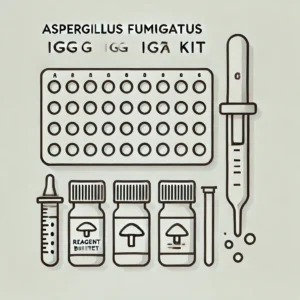
Features of the Aspergillus fumigatus IgG ELISA Kit
- High Sensitivity and Specificity: The kit ensures accurate detection of A. fumigatus-specific IgG antibodies, minimizing false positives and negatives. Learn more about assay validation at NIST.
- Easy-to-Use Protocol: The assay follows a standard ELISA workflow, with pre-coated plates and ready-to-use reagents.
- Quantitative Results: Provides precise quantification of IgG levels, enabling effective diagnosis and monitoring.
- Wide Sample Compatibility: Suitable for serum and plasma samples. For guidelines on sample handling, refer to CDC Laboratory Standards.
How the Aspergillus fumigatus IgG ELISA Kit Works
The enzyme-linked immunosorbent assay (ELISA) is a plate-based technique that relies on antigen-antibody interactions. Here’s how the Aspergillus fumigatus IgG ELISA works:
- Antigen Coating: The ELISA plate is pre-coated with A. fumigatus-specific antigens.
- Sample Addition: Patient serum or plasma is added to the plate, allowing A. fumigatus-specific IgG to bind to the antigens.
- Secondary Antibody: An enzyme-linked secondary antibody specific for human IgG is added, forming an antigen-antibody complex.
- Signal Detection: A substrate reacts with the enzyme to produce a measurable colorimetric signal proportional to IgG levels. Detailed methods are available in the NIH Assay Guidance Manual.
Advantages of the Aspergillus fumigatus IgG ELISA Kit
- Rapid Results: Results are typically available within 2-3 hours, enabling timely diagnosis.
- Scalability: The kit supports high-throughput testing, ideal for large-scale studies.
- Reproducibility: Ensures consistent performance across experiments. Learn more about assay reproducibility at FDA Biomarker Qualification Program.
- Cost-Effective: Compared to other diagnostic methods like fungal culture or imaging, ELISA is relatively inexpensive and accessible.

Challenges and Future Directions
While the Aspergillus fumigatus IgG ELISA Kit is a powerful tool, some challenges remain:
- Cross-Reactivity: Potential for cross-reactivity with other fungal antigens. Advances in antigen purification are detailed at NIH Fungal Pathogen Database.
- Standardization: Variability in IgG cutoffs across laboratories can affect diagnostic accuracy. Read about global standardization efforts at WHO.
- Emerging Technologies: Techniques like proteomics and multiplex assays are being developed to complement ELISA. Visit NIH Proteomics Research for updates.
Conclusion
The Aspergillus fumigatus IgG ELISA Kit is an indispensable tool for diagnosing and monitoring fungal infections. Its high sensitivity, specificity, and ease of use make it ideal for both clinical and research applications. As fungal diseases continue to pose a global health challenge, this assay remains at the forefront of diagnostics and research.
For further resources, visit:

Understanding Rhesus CTL Plasma ACD 25 mL: Applications, Benefits, and Scientific Insights
LRRN3 Rabbit Polyclonal Antibody: A Key Tool for Molecular and Cellular Research
ADVANTAGES AND DISADVANTAGES OF THE DIFFERENT TYPES OF ELISA
About Author
