
Poultry Avian Influenza: Surveillance, Transmission, and Biosecurity Measures
Avian Influenza (AI), frequently referred to as bird flu in poultry, is a viral zoonotic disease caused by influenza A viruses. These viruses are of major concern due to their capacity for rapid transmission, mutation, and inter-species spread, especially in densely populated commercial poultry systems.
Overview of Avian Influenza Virus in Poultry
The AI virus is classified based on two surface glycoproteins: Hemagglutinin (H) and Neuraminidase (N), yielding subtypes such as H5N1, H7N9, H5N8, and others. The Centers for Disease Control and Prevention (CDC) provides an overview of AI virus subtypes and classifications, separating viruses into:
-
Low Pathogenic Avian Influenza (LPAI) – often asymptomatic or mild
-
Highly Pathogenic Avian Influenza (HPAI) – systemic, lethal in poultry
A full database of avian influenza strains is available from the National Center for Biotechnology Information (NCBI).
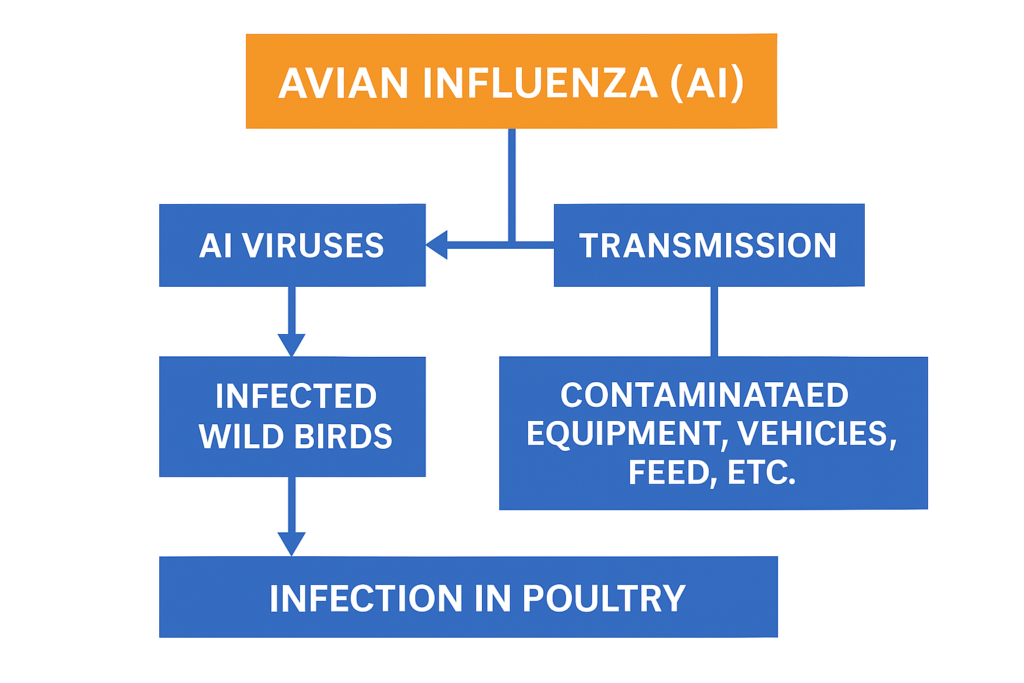
Virus Reservoirs and Transmission Dynamics
Wild aquatic birds are the natural reservoir of AI viruses. Migratory waterfowl, especially ducks and geese, play a significant role in virus maintenance and transmission to commercial poultry flocks.
-
The US Geological Survey (USGS) documents avian influenza circulation in wild birds.
-
University of Minnesota Extension outlines how the virus can spread to backyard and commercial flocks through fecal contamination, shared water sources, and fomites.
Clinical Signs in Chickens and Turkeys
Clinical presentation varies depending on the pathogenicity:
-
HPAI in chickens causes cyanosis, edema of the comb and wattles, hemorrhages, and sudden death.
-
LPAI may result in mild respiratory signs, diarrhea, and drop in egg production.
The Cornell University Veterinary Diagnostic Lab offers detailed diagnostic support and clinical sign documentation.
Diagnostic Techniques and Lab Confirmation
Effective diagnostic workflows include:
-
Real-time RT-PCR (rRT-PCR) (CDC guidelines)
-
Virus isolation in embryonated eggs
-
Hemagglutination Inhibition (HI) and ELISA tests
-
Confirmatory testing by USDA’s National Veterinary Services Laboratories (NVSL) (official protocols)
Surveillance data are stored in the National Animal Health Laboratory Network (NAHLN) (NAHLN info).
National Surveillance Programs
The USDA’s National Poultry Improvement Plan (NPIP) integrates regular AI testing in hatcheries and production sites (NPIP program link).
-
APHIS provides real-time outbreak updates and zone mapping.
-
FAO and WOAH offer harmonized reporting guidelines globally.
Biosecurity Measures in Poultry Facilities
Biosecurity protocols are essential to mitigate introduction and spread of AI:
-
Restricted access zones for personnel
-
Sanitation stations at entry points
-
Wild bird exclusion systems (nets, barriers)
-
Proper disposal of dead birds
University of Georgia Extension provides a comprehensive biosecurity guide for poultry producers.
Additionally, the USDA Biosecurity for Birds program has printable biosecurity checklists and educational flyers for small flock owners.
Reporting Suspicious Cases and Emergency Response
Farms experiencing high mortality or sudden illness are urged to contact local or federal authorities. The USDA recommends prompt reporting of all suspected AI cases.
For confirmed HPAI cases:
-
Immediate quarantine and depopulation
-
Compensation to farmers for euthanized flocks
Human Health Risk and Zoonotic Transmission
Although rare, AI subtypes like H5N1 and H7N9 have infected humans through close contact with poultry, resulting in severe pneumonia, multi-organ failure, and death.
-
The National Institute of Allergy and Infectious Diseases (NIAID) offers research on avian-human transmission and vaccine design.
-
NIH research focuses on universal flu vaccines targeting AI strains.
Economic Impact of Avian Influenza on Poultry Industry
AI outbreaks lead to:
-
Mass culling of millions of birds
-
Disruption of egg and meat supply chains
-
International trade restrictions on poultry exports
The USDA Economic Research Service (ERS) tracks economic losses and recovery.
According to Iowa State Extension, the 2015 outbreak resulted in losses exceeding $3.3 billion.
Vaccination and Research Advances
Though controversial, vaccination is used in some countries to control AI. In the U.S., emergency vaccination is considered under strict USDA control.
-
University of California, Davis leads studies on avian flu vaccine strategies
-
The CDC provides updates on avian influenza vaccine candidates for humans and animals

Future Outlook and Preparedness
Continued global surveillance, genetic sequencing of AI strains, and public-private collaboration are key to early detection, containment, and mitigation of future outbreaks.
The National Wildlife Health Center supports the U.S. government in mapping wild bird migration routes to predict AI hotspots.
The USDA FAD PReP framework serves as a blueprint for coordinated emergency response (FAD PReP PDF).
Final Thoughts
Avian influenza in poultry continues to be a top-tier threat to global agriculture, animal health, and public health. Continuous improvement in surveillance, diagnostics, biosecurity training, and genomic research is critical.

Luminex® MAGPIX® Shigella sonnei PCR Quality Control
Optimizing Giemsa Stain PR80 for Accurate Cytogenetic Analysis in Cancer Diagnostics
Sheep Plasma K3EDTA (Unfl) — Research-Grade Matrix, Chelation Chemistry, and Pre-Analytical Controls
About Author
