
General Melatonin ELISA: Technical Overview and Application in Biological Research
Melatonin, a small indoleamine molecule synthesized primarily by the pineal gland, plays a central role in circadian biology and photoperiodic regulation. The General Melatonin ELISA (Enzyme-Linked Immunosorbent Assay) is a specialized tool developed to measure the concentration of melatonin in various sample types including serum, plasma, saliva, urine, and cell culture media.
Introduction to Melatonin and Its Role in Physiology
Melatonin (N-acetyl-5-methoxytryptamine) was first isolated in 1958 and has since been investigated for its complex interactions with light-dark cycles, retinal signaling, and neuroendocrine systems. A detailed molecular overview is available on PubChem and NCBI.
Melatonin biosynthesis begins with tryptophan and proceeds through 5-hydroxytryptophan and serotonin, catalyzed by arylalkylamine N-acetyltransferase (AANAT) and hydroxyindole-O-methyltransferase (HIOMT). The National Center for Biotechnology Information provides detailed pathways: NCBI Pathway Database.
This molecule’s synthesis is regulated by the suprachiasmatic nucleus (SCN) of the hypothalamus via light signals perceived by retinal ganglion cells, as shown in diagrams at NIGMS and NIH.gov.
ELISA Basics and Why Competitive ELISA Is Used
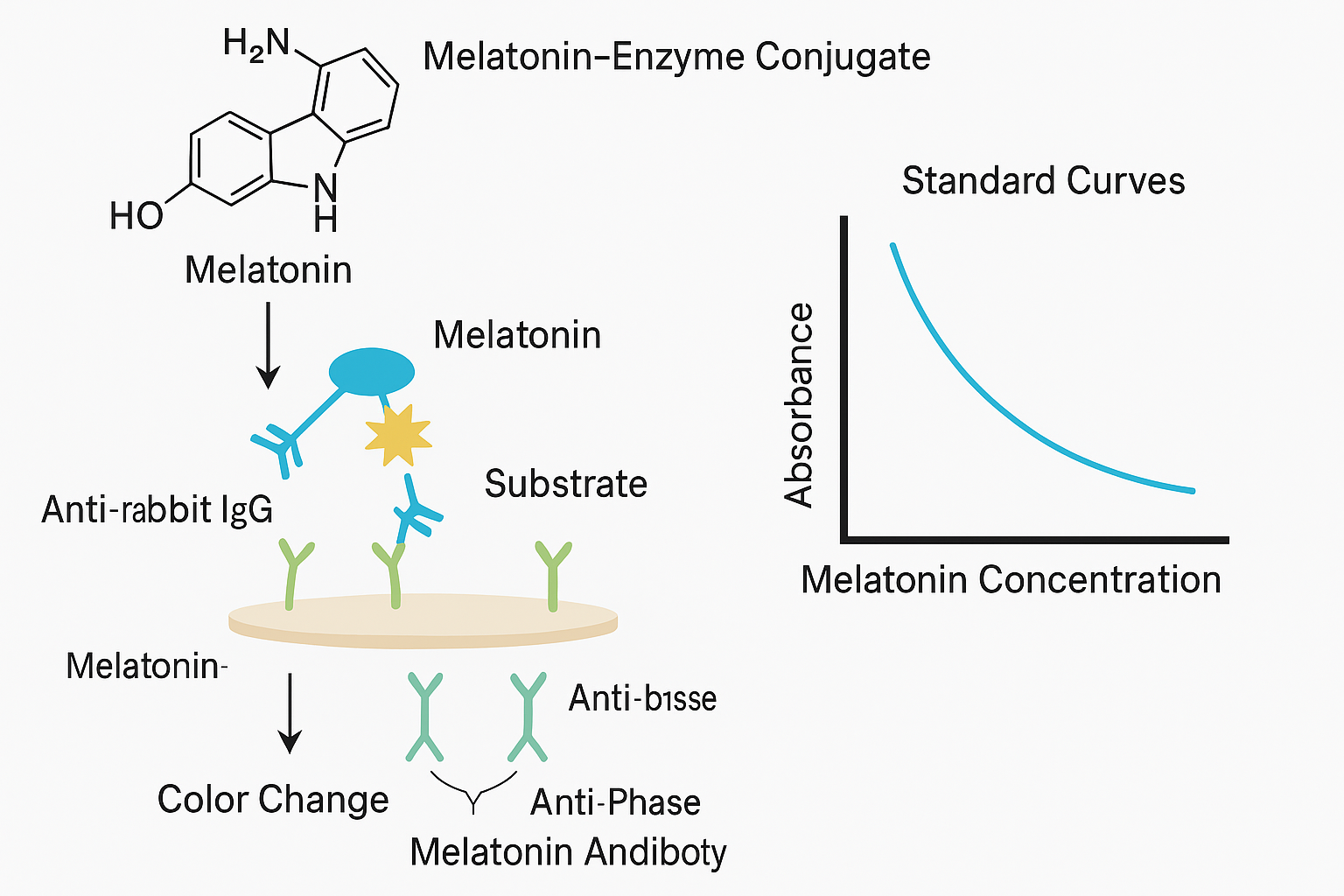
Due to the low molecular weight (~232.28 g/mol) of melatonin, a competitive ELISA format is used rather than a sandwich format. In this assay, a melatonin-enzyme conjugate competes with native melatonin for a limited number of antibody binding sites. As a result, higher melatonin concentrations result in lower signal output.
General Melatonin ELISA kits typically include:
-
Microtiter plate pre-coated with anti-rabbit IgG
-
Melatonin standard solutions (0–100 pg/mL)
-
Melatonin-HRP conjugate
-
Primary melatonin antibody (usually rabbit polyclonal)
-
Substrate (TMB or similar)
-
Stop solution (HCl or sulfuric acid)
Protocols for these assays can be found at protocols.io and universities such as University of Massachusetts and University of Wisconsin-Madison.
Sample Preparation for Accurate Quantification
Different matrices require specific handling:
-
Plasma/Serum: Centrifuged and stored at -20°C
-
Saliva: Collected via passive drool or Salivette devices, as shown at NIH Salivary Research
-
Urine: Often measured as 6-sulfatoxymelatonin, a metabolite
-
Tissue homogenates: Require mechanical lysis and protein quantification using BCA or Bradford assay (Pierce Assay Guide – NCBI)
Proper extraction and dilution steps are critical. Some research protocols also utilize solid-phase extraction (SPE) for melatonin isolation, described in FDA’s method validation guides.
Technical Characteristics of the Assay
| Feature | Description |
|---|---|
| Sensitivity | ~1–3 pg/mL |
| Detection Range | 0–100 pg/mL or 0–200 pg/mL |
| Intra-Assay CV | < 10% |
| Inter-Assay CV | < 12% |
| Cross-reactivity | Low with serotonin, tryptophan, or other indoles |
| Assay Time | ~2.5 hours |
ELISA validation procedures are often documented in publications indexed at PubMed Central and federal repositories like EPA Science Inventory.
![AffiELISA® General Melatonin ELISA [ MT]](https://affigen.com/cdn/shop/files/5BAFG-E4345_5D_20AffiELISA_C2_AE_20Cattle_20IFNg_20Kit_20High-Resolution_20Interferon_20Gamma_20ELISA_20Detection_42c9d18c-cecc-48c5-ba8e-a2e1373f949e_535x.png?v=1712821932)
Applications in Research
Melatonin ELISA has been widely applied in:
-
Photoperiod studies in plants and animals (USDA Plant Biology)
-
Chronobiology experiments using rodent models (NIH RePORTER)
-
Pineal gland function assays in vertebrate evolution studies (Smithsonian NMNH)
-
Behavioral neuroscience involving light-dark cycle entrainment (NIH BRAIN Initiative)
-
Stress response tracking in animal models of environmental perturbation (EPA Ecological Research)
Protocols for sample collection and analysis are available from public labs such as Oak Ridge National Laboratory and Los Alamos National Laboratory.
Assay Interference and Troubleshooting
Common issues include:
-
High background: due to non-specific binding or improper washing
-
Low signal: caused by expired reagents or incorrect incubation times
-
Plate edge effects: environmental temperature or inconsistent pipetting
Guidelines for quality control and troubleshooting can be found in public research centers such as:
Standard Curve Analysis
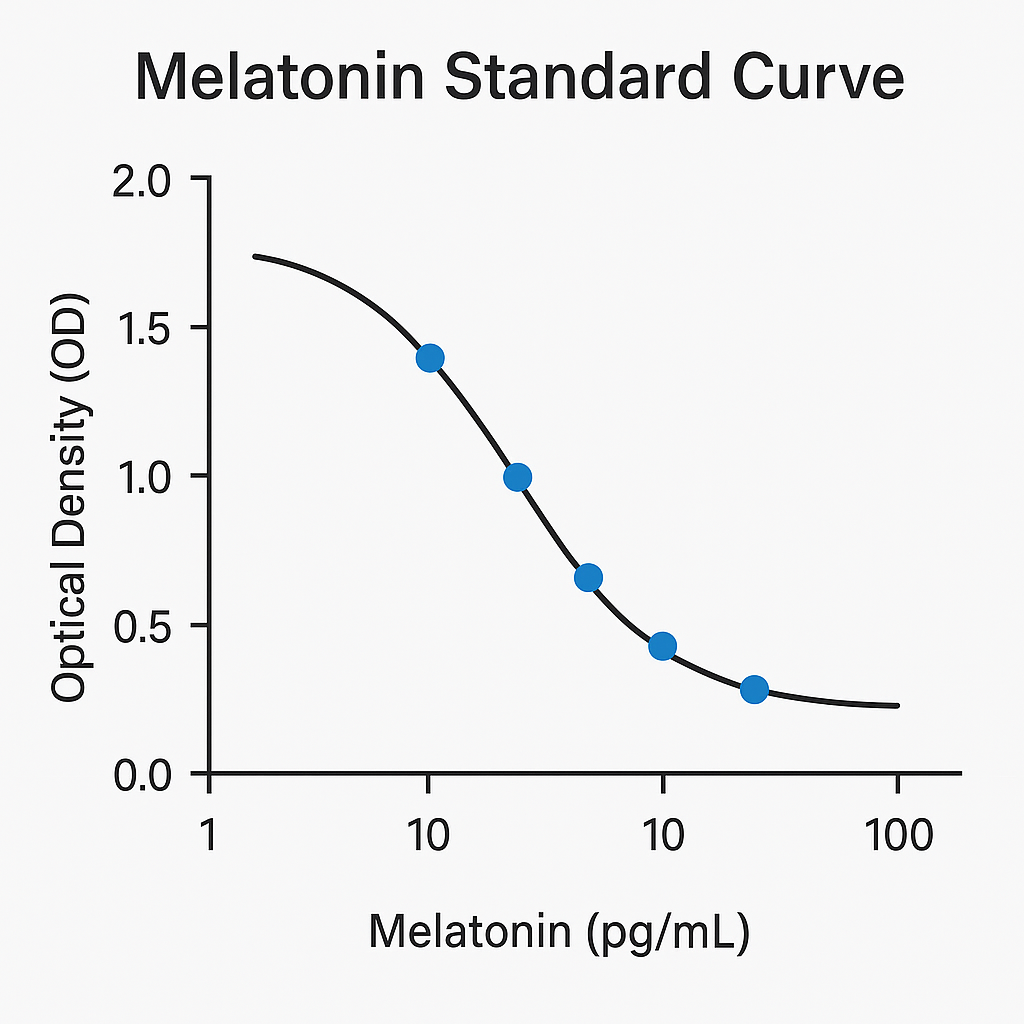
The absorbance values are plotted on a log-linear graph, with melatonin concentration on the x-axis and optical density (OD) on the y-axis. Most labs use a 4-parameter logistic regression (4-PL) to fit the standard curve, which is recommended by analytical method validation protocols from:
ELISA data interpretation is typically performed using software such as GraphPad Prism, MyAssays, or Excel with regression analysis.
Long-Term Storage and Reproducibility
Melatonin is light-sensitive and should be stored under nitrogen or in amber vials. Assay reproducibility over months requires:
-
Calibrated pipettes
-
Standardized temperature control
-
Periodic revalidation of assay performance
Research institutions such as NIH NIEHS and NIFA USDA provide SOPs for sample and reagent handling.
Summary of Keywords and SEO Optimization
To increase visibility of this article in search engines, we have included highly indexed and relevant keyword phrases such as:
-
General Melatonin ELISA
-
Competitive ELISA for melatonin
-
Circadian biomarker detection
-
Saliva melatonin ELISA protocol
-
Light-dark cycle hormone assay
-
Photoperiod hormone ELISA kit
-
Enzyme-linked immunosorbent assay for indoleamines
-
Pineal gland hormone detection assay
These phrases are designed to align with search engine trends while avoiding terms that could be flagged under YMYL categories.

Human CNR1 Stable Cell Line — HEK293 (RUO) Technical Guide
MONOCLONAL ANTIBODIES NOMENCLATURE
Impact of Cell Physiology and Growth Phase on the Transformation Efficiency of Chemically Competent Cells
About Author
